
A Plan for Resiliency
To protect Lower Manhattan from flooding, the new waterfront must be resilient while also maintaining critical functions and enhancing public destinations. The FiDi-Seaport Climate Resilience Plan is guided by three overarching goals:
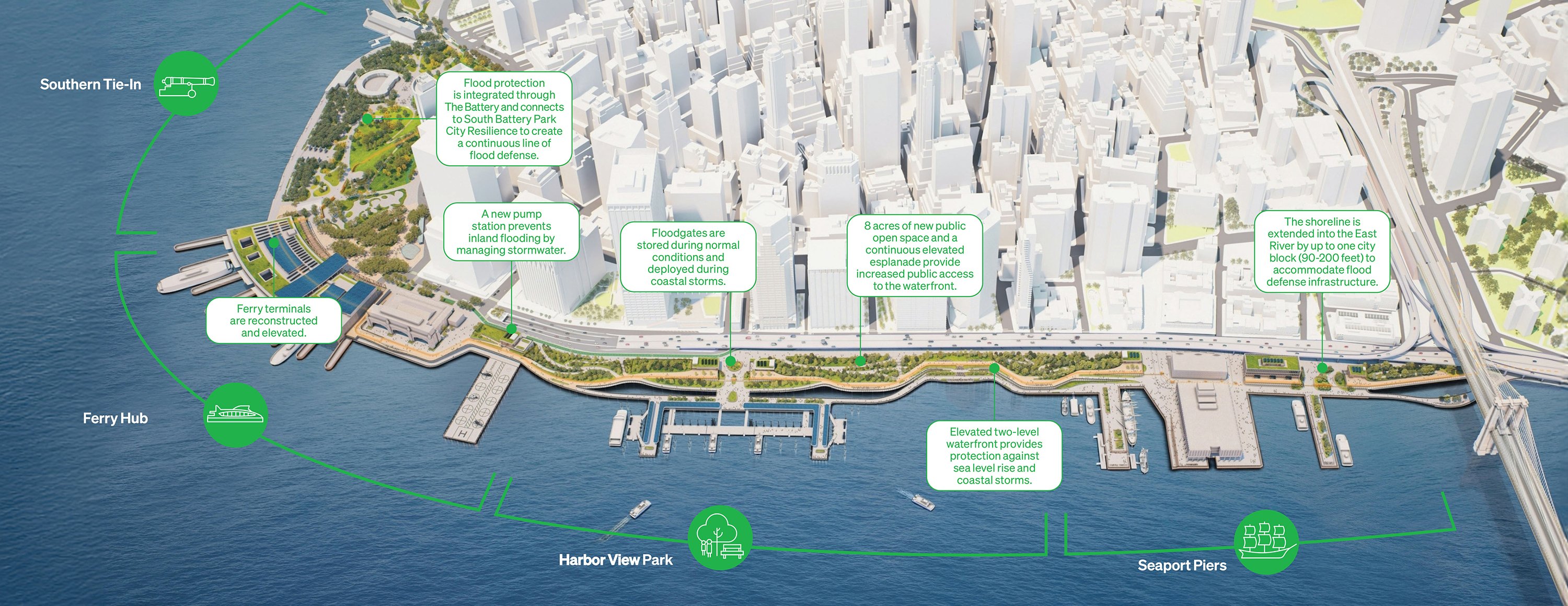
- Protect Lower Manhattan from daily tidal flooding and coastal storms through a multilevel flood-defense system and new drainage infrastructure. The shoreline will need to be extended into the East River to ensure that the flood defense does not wall off the city from the water.
- Integrate climate resilience infrastructure into the city by building new resilient maritime facilities.
- Enhance the public waterfront experience by creating new public open spaces and community-serving uses that are universally accessible.

Moving FiDi-Seaport Forward: Closing the Coastal Protection Gap
Download the 2025 report on the latest design and implementation strategy.
Read the ReportProgress Made Since 2021 Master Plan
The design in the 2021 Master Plan has been further refined to be implementable based on technical studies and cost optimization. This work has been guided by extensive technical studies and engagement with community members, the Climate Coalition of Lower Manhattan, City agency partners, ferry operators, maritime users, environmental advocates, community members, and other stakeholders.
Following the Master Plan, the City has:
- Reached 30 percent design of the flood infrastructure to be technically feasible, cost effective, and implementable.
- Developed a concept design for the southern flood-defense alignment through The Battery to adjacent resilience projects.
- Finalized the footprint of the project in the East River, which is required to begin the environmental review and permitting process.
- Advanced funding and governance strategy.
-
Engagement Process & Findings Elaborates on Chapter 2: Master Plan Process, “Building a Shared Vision”
-
Existing Conditions Assessment Elaborates on Chapter 3: Waterfront Past to Present, “The Waterfront Today”
-
Estimated Costs of Inaction Elaborates on Chapter 4: The Impacts of Climate Change, “What Happens if Nothing is Done?”
-
Flood Defense Alignment Studies Elaborates on Chapter 5: A Resilient 21st-Century Waterfront; “Flood Defense”
-
Stormwater Management Studies Elaborates on Chapter 5: A Resilient 21st-Century Waterfront; “Stormwater Management”
-
Access and Circulation Studies Elaborates on Chapter 5: A Resilient 21st-Century Waterfront; “Access and Circulation”
-
Transportation & Maritime Infrastructure Studies Elaborates on Chapter 5: A Resilient 21st-Century Waterfront; “Maritime”
-
Hydrodynamic Modeling Results Elaborates on Chapter 5: A Resilient 21st-Century Waterfront; “Maritime”
-
Sampling & Testing Year 1 and 2 Elaborates on Chapter 5: A Resilient 21st-Century Waterfront; “Ecology”
-
Public Open Spaces and Public Serving Uses Studies Elaborates on Chapter 5: A Resilient 21st-Century Waterfront; “Public Open Spaces and Public-Serving Uses”
-
Detailed Master Plan Design Rationale and Drawings Elaborates on Chapter 5: A Resilient 21st-Century Waterfront; “Shaping a Resilient 21st-Century Waterfront”
-
Early project Cost Estimates Elaborates on Chapter 6: Implementation Roadmap; “Funding and Financing”
-
Paying for the Master Plan: Potential Options Elaborates on Chapter 6: Implementation Roadmap; “Funding and Financing”
Technical Feasibility
The FiDi-Seaport Climate Resilience Plan’s success is dependent on the technical feasibility of the design to protect Lower Manhattan from flooding while maintaining the critical functions that the waterfront provides today. Extensive engineering and analysis have informed the design to ensure that the project is implementable and is responsive to environmental constraints and the needs of waterfront users.
Stay in the Know
Receive our emails with updates and event invitations.